Anthem on the Hymntune "Kingsfold" - No Tramp of Soldiers' Marching Feet
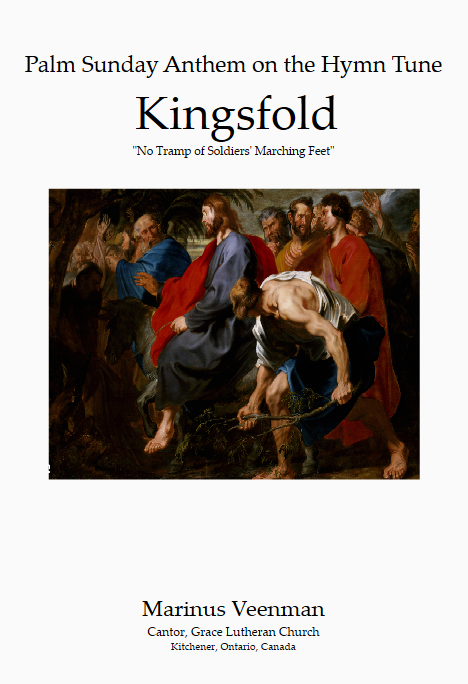
Anthem on the Hymntune "Kingsfold" - No Tramp of Soldiers' Marching Feet
A festive SSAATTBB anthem with organ on the folk hymn-tune KINGSFOLD, set to Timothy Dudley-Smith’s Palm Sunday text “No Tramp of Soldiers’ Marching Feet.” The organ part carries original obbligatos in the ancient mode. Written for the Sunday of the Passion and dedicated to Jillian Veenman on her confirmation, Palm Sunday 2023. The final stanza is the climax: full organ, eight-part choir, and an original descant.
KINGSFOLD is an English folk melody older than the name it now carries. Variants of the tune were sung for generations to ballads such as Dives and Lazarus (the parable of the rich man and Lazarus) and other village songs in England, Ireland, and Scotland. Some scholars hear in it a strain that may reach back to the Middle Ages.
The melody entered print in Lucy E. Broadwood and J. A. Fuller Maitland’s English County Songs (1893), paired there with Dives and Lazarus. On 23 December 1904, Ralph Vaughan Williams heard a related variant from a singer named Booker at The Wheatsheaf in the Sussex hamlet of Kingsfold, near Horsham. Two years later, as music editor of The English Hymnal (1906), he adapted the tune for church use, named it KINGSFOLD after that village, and set it to Horatius Bonar’s “I heard the voice of Jesus say.” He returned to the same family of melodies in his English Folk Song Suite (1923) and Five Variants of Dives and Lazarus (1939). The hymn-book form is modal, strong, and built in rounded bar form (AABA)—dignified enough for worship, and sturdy enough to bear a festival choir.
This anthem sets Timothy Dudley-Smith’s Palm Sunday hymn “No tramp of soldiers’ marching feet” (© 1984 Hope Publishing Co.). The text refuses a military triumph: no drums, no opened city gates. The King comes on a colt; the palms will be thrown down; the crown will be thorn. Stanza 4 turns the whole week: the Servant who bore the cross now reigns, and the church answers with “Behold, behold your King!”
The setting is SSAATTBB with festive organ. It is written to fill a sanctuary on the Sunday of the Passion. The final stanza is the climax: full organ, eight-part choir, and an original descant over the last proclamation.
Written for Palm Sunday and dedicated to my daughter Jillian, confirmed on Palm Sunday 2023.
Dudley-Smith’s hymn is a Palm Sunday meditation that refuses a military triumph and follows the King from the colt to the cross to the reign. Each stanza ends on the same two cries: “the King of glory” and “Behold, behold your King!” — first as expectation, then as mockery, then as confession.
Stanza 1 — What this entry is not
There is no army, no banners, no drums, no martial music. No bells ring for royal pomp; the city gates do not swing wide as they would for a conqueror. The first announcement is therefore a contradiction: the King of glory comes, but not as the world stages a king.
Stanza 2 — How he actually comes
And yet he comes. Children cheer; palms are thrown in the road. Every step toward the city is also a step toward the cross, which the poet already names as “the King of glory’s throne.” He rides a colt, not a warhorse. Hosannas rise; if the crowd were silent, the stones would cry the same acclamation.
Stanza 3 — How quickly the glory fades
The flowers and palms will not last. What looks like a crown of celebration becomes thorn. The soldiers mock; the crowd turns; the streets roar. Pilate presents the beaten Christ to the mob with the same words the hymn has been using in faith — “Behold your King” — now spoken in contempt (the Ecce Homo of John 19).
Stanza 4 — What the Passion finally means
The one who bore the cross and took a servant’s form is the one who now reigns. The last hosanna is no longer a street shout that will die by Friday. It is the song of the ransomed host until heaven itself answers: the same King, the same beholding, now as praise rather than irony.
The argument of the whole hymn
Verse 1 strips away false messianic hope. Verse 2 gives the Gospel scene. Verse 3 walks the same road into Holy Week. Verse 4 is Easter and Ascension heard already on Palm Sunday: the Servant is the King of glory. Dudley-Smith wrote it as a fulfilment of Zechariah 9:9 and as a comment on the disciples’ confusion in John 12:16 — they did not understand the entry until after he was glorified. The repeated “King of glory” also points to Psalm 24.
That is why stanza 4 is the right place for full organ, eight-part choir, and descant: the text has finally said what the first three stanzas only approached.